Adrienne Rich's Compulsory Heterosexuality and Lesbian Existence was a 1980 essay which first appeared in the United Kingdom as a pamphlet pub1ished by Onlywomen Press, and was later published in her 1986 book Blood, Bread, and Poetry (now available as a paperback from Norton, 1994). It was a powerful challenge whose ideas are still contantly being referenced and debated. Some of her arguments are:
That lesbian existence is a more accurate term than lesbianism, and it is far more than mere sexuality -- we are part of a continuum, not reduced to who we go to bed with.
That "part of the lesbian experience is an act of resistance: specifically, a rejection of the patriarchy and the male right to women."
That lesbianism is an extension of feminism (another phrasing of Ti-Grace Atkinson's movement slogan "Feminism is the theory, lesbianism is the practice").
"That to treat the lesbian experience as a version of male homosexuality is to discard it, denying the female experience and the realities it brings, falsifying lesbian history."
That once a greater understanding of lesbian experience is obtained, the boundaries of "women's dependence on men as social and economic supports, as well as for adult sexuality and psychological completion" will be widened and "women will be able to experience the 'erotic' in female terms."
COMPULSORY HETEROSEXUALITY AND LESBIAN EXISTENCE
© by Adrienne Rich 
I. Biologically men have only one innate orientation--a sexual one that draws them to women--while women have two innate orientations, sexual toward men and reproductive toward their young.{1}
I was a woman terribly vulnerable, critical, using femaleness as a sort of standard of yardstick to measure and discard men. Yes -- something like that. I was an Anna who invited defeat from men without ever being conscious of it. (But I am conscious of it. And being conscious of it means I shall leave it all behind me and become--but what?) I was stuck fast in an emotion common to women of our time, that can turn them bitter, or Lesbian, or solitary. Yes, that Anna during that time was . . .
[Another blank line across the page:]{2}
The bias of compulsory heterosexuality, through which lesbian experience is perceived on a scale ranging from deviant to abhorrent, or simply rendered invisible, could be illustrated from many other texts than the two just preceding. The assumption made by Rossi, that women are "innately sexually oriented" toward men, or by Lessing, that the lesbian choice is simply an acting-out of bitterness toward men, are by no means theirs alone; they are widely current in literature and in the social sciences.
I am concerned here with two other matters as well: first, how and why women's choice of women as passionate comrades, life partners co-workers, lovers, tribe, has been crushed, invalidated, forced into hiding and disguise; and second, the virtual or total neglect of lesbian existence in a wide range of writings, Including feminist scholarship. Obviously there is a connection here. I believe that much feminist theory and criticism is stranded on this shoal.
My organizing impulse is the belief that it is not enough for feminist thought that specifically lesbian texts exist. Any theory or cultural/political creation that treats lesbian existence as a marginal or less "natural" phenomenon, as mere "sexual preference," or as the mirror image of either heterosexual or male homosexual relations is profoundly weakened thereby, whatever its other contributions. Feminist theory can no longer afford merely to voice a toleration of "lesbianism" as an "alternative life-style," or make token allusion to lesbians. A feminist critique of compulsory heterosexual orientation for women is long overdue. In this exploratory paper, I shall try to show why.

I will begin by way of examples, briefly discussing four books that have appeared in the last few years, written from different viewpoints and political orientations, but all presenting themselves, and favorably reviewed, as feminist.{3} All take as a basic assumption that the social relations of the sexes are disordered and extremely problematic, if not disabling, for women; all seek paths toward change. I have learned more from some of these books than from others; but on this I am clear: each one might have been more accurate, more powerful, more truly a force for change, had the author felt impelled to deal with lesbian existence as a reality, and as a source of knowledge and power available to women; or with the institution of heterosexuality itself as a beachhead of male dominance.{4} In none of them is the question ever raised, whether in a different context, or other things being equal, women would choose heterosexual coupling and marriage; heterosexuality is presumed as a "sexual preference" of most women," either implicitly or explicitly. In none of these books, which concern themselves with mothering, sex roles, relationships, and societal prescriptions for women, is compulsory heterosexuality ever examined as an institution powerfully affecting all these; or the idea of "preference" or "innate orientation" even indirectly questioned.
In For Her Own Good 150 Years of the Experts' Advice to Women by Barbara Ehrenreich and Deirdre English, the authors' superb pamphlets, Witches, Midwives and Nurses: A History of Women Healers, and Complaints and Disorders: The Sexual Politics of Sickness, are developed into a provocative and complex study Their thesis in this book is that the advice given American women by male health professionals, particularly in the areas of marital sex, maternity, and child care, has echoed the dictates of the economic marketplace and the role capitalism has needed women to play in production and/ or reproduction. Women have become the consumer victims of various cures, therapies, and normative judgments in different periods (including the prescription to middle-class women to embody and preserve the sacredness of the home--the "scientific" romanticization) of the home itself). None of the "experts' " advice has been either particularly scientific or women-oriented; it has reflected male needs, male fantasies about women, and male interest in controlling women--particularly in the realms of sexuality and motherhood--fused with the requirements of industrial capitalism. So much of this book is so devastatingly informative and is written with such lucid feminist wit that I kept waiting as I read for the basic prescription against lesbianism to he examined. It never was.
This can hardly be for lack of information. Jonathan Katz's Gay American History{5} tells us that as early as 1656 the New Haven Colony prescribed the death penalty for lesbians. Katz provides many suggestive and informative documents on the "treatment" (or torture) of lesbians by the medical profession in the nineteenth and twentieth centuries. Recent work by the historian Nancy Sahli documents the crackdown on intense female friendships among college women at the turn of the present century{6}. The ironic title For Her Own Good might have referred first and foremost to the economic imperative to heterosexuality and marriage and to the sanctions imposed against single women and widows--both of whom have been and still are viewed as deviant Yet, in this often enlightening Marxist-feminist overview of male prescriptions for female sanity and health, the economics of prescriptive heterosexuality go unexamined.{7}
 (Salem Normal School female students, circa 1930's)
Of the three psychoanalytically based books, one, Jean Baker Miller's Toward a New Psychology of Women, is written as if lesbians simply do not exist, even as marginal beings. Given Miller's title I find this astonishing. However, the favorable reviews the book has received in feminist journals, including Signs and Spokeswoman, suggest that Miller's heterocentric assumptions are widely shared. In The Mermaid and the Minotaur: Sexual Arrangements and the Human Malaise, Dorothy Dinnerstein makes an impassioned argument for the sharing of parenting between women and men and for an end to what she perceives as the male/female symbiosis of "gender arrangements," which she feels are leading the species further and further into violence and self-extinction. Apart from other problems that I have with this book (including her silence on the institutional and random terrorism men have practiced on women--and children--throughout history, amply documented by Barry, Daly, Griffin, Russell and van de Ven, and Brownmiller{8}, and her obsession with psychology to the neglect of economic and other material realities that help to create psychological reality), I find utterly ahistorical Dinnerstein's view of the relations between women and men as "a collaboration to keep history mad". She means by this, to perpetuate social relations that are hostile, exploitative, and destructive to life itself. She sees women and men as equal partners in the making of "sexual arrangements," seemingly unaware of the repeated struggles of women to resist oppression (our own and that of others) and to change our condition. She ignores, specifically, the history of women who as witches, femmes seules, marriage resisters, spinsters, autonomous widows, and/or lesbians -- have managed on varying levels not to collaborate. It is this history, precisely, from which feminists have so much to learn and on which there is overall such blanketing silence. Dinnerstein acknowledges at the end of her book that "female separatism," though "not on a large scale and in the long run wildly impractical," has something to teach us: "Separate, women could in principle set out to learn from scratch--undeflected by the opportunities to evade this task that men's presence has so far offered--what intact self-creative humanness is."{9} Phrases like "intact self-creative humanness" obscure the question of what the many forms of female separatism have actually been addressing. The fact is that women in every culture and throughout history have undertaken the task of independent, nonheterosexual, woman-connected existence, to the extent made possible by their context, often in the belief that they were the "only ones" ever to have done so. They have undertaken it even though few women have been in an economic position to resist marriage altogether; and even though attacks against unmarried women have ranged from aspersion and mockery to deliberate gynocide, including the burning and torturing of millions of widows and spinsters during the witch persecutions of the fifteenth, sixteenth, and seventeenth centuries in Europe, and the practice of suttee on widows in India.{10}

Nancy Chodorow does come close to the edge of an acknowledgment of lesbian existence. Like Dinnerstein, Chodorow believes that the fact that women, and women only, are responsible for child care in the sexual division of labor has led to an entire social organization of gender inequality, and that men as well as women must become primary carers for children if that inequality is to change. In the process of examining, from a psychoanalytic perspective, how mothering-by-women affects the psychological development of girl and boy children, she offers documentation that men are "emotionally secondary" in women's lives; that "women have a richer, ongoing inner world to fall back on . . . men do not become as emotionally important to women as women do to men"{11}. This would carry into the late twentieth century Smith-Rosenberg's findings about eighteenth- and nineteenth-century women's emotional focus on women. "Emotionally important" can of course refer to anger as well as to love, or to that intense mixture of the two often found in women's relationships with women: one aspect of what I have come to call the "double-life of women" (see below). Chodorow concludes that because women have women as mothers, "The mother remains a primary internal object [sic] to the girl, so that heterosexual relationships are on the model of a nonexclusive, second relationship for her, whereas for the boy they recreate an exclusive, primary relationship". According to Chodorow, women "have learned to deny the limitations of masculine lovers for both psychological and practical reasons.{12}
But the practical reasons (like witch burnings; male control of law, theology, and science; or economic nonviability within the sexual division of labor) are glossed over. Chodorow's account barely glances at the constraints and sanctions that, historically, have enforced or ensured the coupling of women with men and obstructed or penalized our coupling or allying in independent groups with other women. She dismisses lesbian existence with the comment that "lesbian relationships do tend to recreate mother-daughter emotions and connections, but most women are heterosexual" (implied more mature, having developed beyond the mother-daughter connection). She then adds: "This heterosexual preference and taboos on homosexuality, in addition to objective economic dependence on men, make the option of primary sexual bonds with other women unlikely--though more prevalent in recent years."{13} The significance of that qualification seems irresistible -- but Chodorow does not explore it further. Is she saying that lesbian existence has become more visible in recent years (in certain groups?), that economic and other pressures have changed (under capitalism, socialism, or both?), and that consequently more women are rejecting the heterosexual "choice"? She argues that women want children because their heterosexual relationships lack richness and intensity, that in having a child a woman seeks to recreate her own intense relationship with her mother. It seems to be that on the basis of her own findings, Chodorow leads us implicitly to conclude that heterosexuality is not a "preference" for women; that, for one thing, it fragments the erotic from the emotional in a way that women find impoverishing and painful. Yet her book participates in mandating it. Neglecting the covert socializations and the overt forces that have channeled women into marriage and heterosexual romance pressures ranging from the selling of daughters to postindustrial economics to the silences of literature to the images of the television screen, she, like Dinnerstein, is stuck with trying to reform a manmade institution -- compulsory heterosexuality -- as if, despite profound emotional impulses and complementarities drawing women toward women, there is a mystical/biological heterosexual inclination, a "preference" or "choice" that draws women toward men.
Moreover, it is understood that this "preference" does not need to be explained, unless through the tortuous theory of the female Oedipus complex or the necessity for species reproduction. It is lesbian sexuality that (usually, and, incorrectly, "included" under male homosexuality) is seen as requiring explanation. This assumption of female heterosexuality seems to me in itself remarkable: it is an enormous assumption to have glided so silently into the foundations of our thought.
The extension of this assumption is the frequently heard assertion that in a world of genuine equality, where men were nonoppressive and nurturing, everyone would be bisexual. Such a notion blurs and sentimentalizes the actualities within which women have experienced sexuality; it is the old liberal leap across the tasks and struggles of here and now, the continuing process of sexual definition that will generate its own possibilities and choices. (It also assumes that women who have chosen women have done so simply because men are oppressive and emotionally unavailable: which still fails to account for women who continue to pursue relationships with oppressive and/or emotionally unsatisfying men.) I am suggesting that heterosexuality, like motherhood, needs to be recognized and studied as a political institution -- even, or especially, by those individuals who feel they are, in their personal experience, the precursors of a new social relation between the sexes.

II. If women are the earliest sources of emotional caring and physical nurture for both female and male children, it would seem logical, from a feminist perspective at least, to pose the following questions: whether the search for love and tenderness in both sexes does not originally lead toward women; why in fact women would ever redirect that search; why species-survival, the means of impregnation, and emotional/erotic relationships should ever have become so rigidly identified with each other; and why such violent strictures should be found necessary to enforce women's total emotional, erotic loyalty and subservience to men. I doubt that enough feminist scholars and theorists have taken the pains to acknowledge the societal forces that wrench women's emotional and erotic energies away from themselves and other women and from woman-identified values. These forces, as I shall try to show, range from literal physical enslavement to the disguising and distorting of possible options.
I do not, myself, assume that mothering-by-women is a "sufficient cause" of lesbian existence. But the issue of mothering-by-women has been much in the air of late, usually accompanied by the view that increased parenting by men would minimize antagonism between the sexes and equalize the sexual imbalance of power of males over females. These discussions are carried on without reference to compulsory heterosexuality as a phenomenon let alone as an ideology. I do not wish to psychologize here, but rather to identify sources of male power. I believe large numbers of men could, in fact, undertake child care on a large scale without radically altering the balance of male power in a male-identified society.
In her essay "The Origin of the Family," Kathleen Gough lists eight characteristics of male power in archaic and contemporary societies that I would like to use as a framework: "men's ability to deny women sexuality or to force it upon them; to command or exploit their labor to control their produce; to control or rob them of their children; to confine them physically and prevent their movement; to use them as objects in male transactions; to cramp their creativeness; or to withhold from them large areas of the society's knowledge and cultural attainments."{14} (Gough does not perceive these power-characteristics as specifically enforcing heterosexuality; only as producing sexual inequality.) Below, Gough's words appear in italics; the elaboration of each of her categories, in brackets, is my own.
Characteristics of male power include the power of men:
1. to deny women [our own] sexuality
[by means of clitoridectomy and infibulation; chastity belts; punishment, including death, for female adultery; punishment, including death, for lesbian sexuality; psychoanalytic denial of the clitoris; strictures against masturbation; denial of material and postmenopausal sensuality; unnecessary hysterectomy; pseudolesbian images in media and literature; closing of archives and destruction of documents relating to lesbian existence];
2. or to force it [male sexuality] upon them
by means of rape (including marital rape) and wife beating; father-daughter, brother-sister incest; the socialization of women to feel that male sexual "drive" amounts to a right,{15} idealization of heterosexual romance in art, literature, media, advertising, and so forth; child marriage; arranged marriage; prostitution; the harem; psychoanalytic doctrines of frigidity and vaginal orgasm; pornographic depictions of women responding pleasurably to sexual violence and humiliation (a subliminal message being that sadistic heterosexuality is more "normal" than sensuality between women)];
3. to command or exploit their labor to control their produce
[by means of the institutions of marriage and motherhood as unpaid production; the horizontal segregation of women in paid employment; the decoy of the upwardly mobile token woman; male control of abortion, contraception, and childbirth; enforced sterilization; pimping, female infanticide, which robs mothers of daughters and contributes to generalized devaluation of women];
4. to control or rob them of their children
[by means of father-right and "legal kidnapping";{16} enforced sterilization; systematized infanticide; seizure of children from lesbian mothers by the courts, the malpractice of male obstetrics; use of the mother as "token torturer"{17} in genital mutilation or in binding the daughter's feet (or mind) to fit her for marriage];
5. to confine them physically and prevent their movement
[by means of rape as terrorism, keeping women off the streets; purdah, foot-binding; atrophying of women's athletic capabilities; haute couture, "feminine" dress codes; the veil; sexual harassment on the streets, horizontal segregation of women in employment; prescriptions for "full-time" mothering; enforced economic dependence of wives];
6. to use them as objects in male transactions
[use of women as "gifts," bride-price; pimping; arranged marriage; use of women as entertainers to facilitate male deals, for example, wife-hostess, cocktail waitress required to dress for male sexual titillation, call girls, "bunnies," geisha, kisaeng prostitutes, secretaries];
7. to cramp their creativeness
[witch persecutions as campaigns against midwives and female healers and as pogrom against independent, "unassimilated" women;{18} definition of male pursuits as more valuable than female within any culture, so that cultural values become embodiment of male subjectivity, restriction of female self-fulfillment to marriage and motherhood, sexual exploitation of women by male artists and teachers; the social and economic disruption of women's creative aspirations;{19} erasure of female tradition];{20} and
8. to withhold from them large areas of the society's knowledge and cultural attainments
[by means of noneducation of females (60 percent of the world's illiterates are women); the "Great Silence" regarding women and particularly lesbian existence in history and culture;{21} sex-role stereotyping that deflects women from science, technology, and other "masculine" pursuits; male social/professional bonding that excludes women; discrimination against women in the professions]
These are some of the methods by which male power is manifested and maintained. Looking at the schema, what surely impresses itself is the fact that we are confronting not a simple maintenance of inequality and property possession, but a pervasive cluster of forces, ranging from physical brutality to control of consciousness, that suggests that an enormous potential counterforce is having to be restrained.
Some of the forms by which male power manifests itself are more easily recognizable as enforcing heterosexuality on women than are others. Yet each one I have listed adds to the cluster of forces within which women have been convinced that marriage and sexual orientation toward men are inevitable, even if unsatisfying or oppressive components of their lives. The chastity belt; child marriage; erasure of lesbian existence (except as exotic and perverse) in art, literature, film; idealization of heterosexual romance and marriage -- these are some fairly obvious forms of compulsion, the first two exemplifying physical force, the second two control of consciousness. While clitoridectomy has been assailed by feminists as a form of woman-torture,{22} Kathleen Barry first pointed out that it is not simply a way of turning the young girl into a "marriageable" woman through brutal surgery; it intends that women in the intimate proximity of polygynous marriage will not form sexual relationships with each other; that -- from a male, genitalfetishist perspective -- female erotic connections, even in a sex segregated situation, will be literally excised.{23}
The function of pornography as an influence on consciousness is a major public issue of our time, when a multibillion-dollar industry has the power to disseminate increasingly sadistic, women-degrading visual images. But even so-called soft-core pornography and advertising depict women as objects of sexual appetite devoid of emotional context, without individual meaning or personality: essentially as a sexual commodity to be consumed by males. (So-called lesbian pornography, created for the male voyeuristic eye, is equally devoid of emotional context or individual personality.) The most pernicious message relayed by pornography is that women are natural sexual prey to men and love it; that sexuality and violence are congruent; and that for women sex is essentially masochistic, humiliation pleasurable, physical abuse erotic. But along with this message comes another, not always recognized: that enforced submission and the use of cruelty, if played out in heterosexual pairing, is sexually "normal," while sensuality between women, including erotic mutuality and respect, is "queer," "sick," and either pornographic in itself or not very exciting compared with the sexuality of whips and bondage.{24} Pornography does not simply create a climate in which sex and violence are interchangeable, it widens the range of behavior considered acceptable from men in heterosexual intercourse -- behavior that reiteratively strips women of their autonomy, dignity, and sexual potential, including the potential of loving and being loved by women in mutuality and integrity.
 (Catherine A. MacKinnon)
In her brilliant study Sexual Harassment of Working Women: A Case of Sex Discrimination, Catharine A. MacKinnon delineates the intersection of compulsory heterosexuality and economics. Under capitalism, women are horizontally segregated by gender and occupy a structurally inferior position in the workplace; this is hardly news, but MacKinnon raises the question why, even if capitalism "requires some collection of individuals to occupy low-status, low-paying positions such persons must be biologically female," and goes on to point out that "the fact that male employers often do not hire qualified women, even when they could pay them less than men, suggests that more than the profit motive is implicated" (emphasis added).{25} She cites a wealth of material documenting the fact that women are not only segregated in low-paying service jobs (as secretaries, domestics, nurses, typists, telephone operators, child-care workers, waitresses) but that "sexualization of the woman" is part of the job. Central and intrinsic to the economic realities of women's lives is the requirement that women will "market sexual attractiveness to men, who tend to hold the economic power and position to enforce their predilections." And MacKinnon exhaustively documents that "sexual harassment perpetuates the interlocked structure by which women have been kept sexually in thrall to men at the bottom of the labor market. Two forces of American society converge: men's control over women's sexuality and capital's control over employees' work lives."{26} Thus, women in the workplace are at the mercy of sex-as-power in a vicious circle. Economically disadvantaged, women--whether waitresses or professors--endure sexual harassment to keep their jobs and learn to behave in a complaisantly and ingratiatingly heterosexual manner because they discover this is their true qualification for employment, whatever the job description. And, MacKinnon notes, the woman who too decisively resists sexual overtures in the workplace is accused of being "dried-up" and sexless, or lesbian. This raises a specific difference between the experiences of lesbians and homosexual men. A lesbian, closeted on her job because of heterosexist prejudice, is not simply forced into denying the truth of her outside relationships or private life; her job depends on her pretending to be not merely heterosexual but a heterosexual woman, in terms of dressing and playing the feminine, deferential role required of "real" women.
MacKinnon raises radical questions as to the qualitative differences between sexual harassment, rape, and ordinary heterosexual intercourse. ("As one accused rapist put it, he hadn't used 'any more force than is usual for males during the preliminaries.'") She criticizes Susan Brownmiller{27} for separating rape from the mainstream of daily life and for her unexamined premise that "rape is violence, intercourse is sexuality," removing rape from the sexual sphere altogether. Most crucially she argues that "taking rape from the realm of 'the sexual,' placing it in the realm of 'the violent,' allows one to be against it without raising any questions about the extent to which the institution of heterosexuality has defined force as a normal part of 'the preliminaries."{28} Never is it asked whether, under conditions of male supremacy, the notion of 'consent' has any meaning."{29}
The fact is that the workplace, among other social institutions, is a place where women have learned to accept male violation of our psychic and physical boundaries as the price of survival; where women have been educated - no less than by romantic literature or by pornography - to perceive ourselves as sexual prey. A woman seeking to escape such casual violations along with economic disadvantage may well turn to marriage as a form of hoped-for protection, while bringing into marriage neither social nor economic power, thus entering that institution also from a disadvantaged position. MacKinnon finally asks:
What if inequality is built into the social conceptions of male and female sexuality, of masculinity and femininity, of sexiness and heterosexual attractiveness? Incidents of sexual harassment suggest that male sexual desire itself may be aroused by female vulnerability.... Men feel they can take advantage, so they want to, so they do. Examination of sexual harassment, precisely because the episodes appear commonplace, forces one to confront the fact that sexual intercourse normally occurs between economic (as well as physical) unequals.... the apparent legal requirement that violations of women's sexuality appear out of the ordinary before they will be punished helps prevent women from defining the ordinary conditions of their own consent.{30}
Given the nature and extent of heterosexual pressures, the daily "eroticization of women's subordination" as MacKinnon phrases it,{31} I question the more or less psychoanalytic perspective (suggested by such writers as Karen Horney, H. R. Hayes, Wolfgang Lederer, and most recently, Dorothy Dinnerstein) that the male need to control women sexually results from some primal male "fear of women" and of women's sexual instatiability. It seems more probable that men really fear, not that they will have women's sexual appetites forced on them, or that women want to smother and devour them, but that women could be indifferent to them altogether, that men could be allowed sexual and emotional - therefore economic - access to women only on women's terms, otherwise being left on the periphery of the matrix.
The means of assuring male sexual access to women have recently received a searching investigation by Kathleen Barry.{32} She documents extensive and appalling evidence for the existence, on a very large scale, of international female slavery, the institution once known as "white slavery" but that in fact has involved, and at this very moment involves, women of every race and class. In the theoretical analysis derived from her research, Barry makes the connection between all enforced conditions under which women live subject to men: prostitution, marital rape, father-daughter and brother-sister incest, wife-beating, pornography, bride-price, the selling of daughters, purdah, and genital mutilation. She sees the rape paradigm -- where the victim of sexual assault is held responsible for her own victimization -- as leading to the rationalization and acceptance of other forms of enslavement where the woman is presumed to have "chosen" her fate, to embrace it passively, or to have courted it perversely through rash or unchaste behavior. On the contrary, Barry maintains, "female sexual slavery is present in ALL situations where women or girls cannot change the conditions of their existence; where regardless of how they got into those conditions, e g., social pressure, economic hardship, misplaced trust or the longing for affection, they cannot get out; and where they are subject to sexual violence and exploitation."{33} She provides a spectrum of concrete examples, not only as to the existence of a widespread international traffic in women, but also as to how this operates -- whether in the form of a "Minnesota pipeline" funneling blonde, blue eyed midwestern runaways to Times Square, or the purchasing of young women out of rural poverty in Latin America or Southeast Asia or the providing of maisons d'abattage for migrant workers in the eighteenth arrondissement of Paris. Instead of "blaming the victim" or trying to diagnose her presumed pathology, Barry turns her floodlight on the pathology of sex colonization itself, the ideology of "cultural sadism" represented by the vast industry of pornography and by the overall identification of women primarily as "sexual beings whose responsibility is the sexual service of men."{34}
Barry delineates what she names a "sexual domination perspective" through whose lens, purporting objectivity, sexual abuse and terrorism of women by men has been rendered almost invisible by treating it as natural and inevitable. From its point of view, women are expendable as long as the sexual and emotional needs of the male can be satisfied. To replace this perspective of domination with a universal standard of basic freedom for women from gender-specific violence, from constraints on movement, and from male right of sexual and emotional access is the political purpose of her book. Like Mary Daily in Gyn/Ecology, Barry rejects structuralist and other cultural-relativist rationalizations for sexual torture and anti-woman violence. In her opening chapter, she asks of her readers that they refuse all handy escapes into ignorance and denial. "The only way we can come out of hiding, break through our paralyzing defenses, is to know it all -- the full extent of sexual violence and domination of women... In knowing, in facing directly, we can learn to chart our course out of this oppression, by envisioning and creating a world which will preclude female sexual slavery "{35}
"Until we name the practice, give conceptual definition and form to it, illustrate its life over time and in space, those who are its most obvious victims will also not be able to name it or define their experience."{36}
But women are all, in different ways and to different degrees, its victims; and part of the problem with naming and conceptualizing female sexual slavery is, as Barry clearly sees, compulsory heterosexuality. Compulsory heterosexuality simplifies the task of the procurer and pimp in worldwide prostitution rings and "eros centers," while, in the privacy of the home, it leads the daughter to "accept" incest/rape by her father, the mother to deny that it is happening, the battered wife to stay on with an abusive husband. "Befriending or love" is a major tactic of the procurer whose job it is to turn the runaway or the confused young girl over to the pimp for seasoning. The ideology of heterosexual romance, beamed at her from childhood out of fairy tales, television, films, advertising, popular songs, wedding pageantry, is a tool ready to the procurer's hand and one he does not hesitate to use, as Barry amply documents. Early female indoctrination in "love" as an emotion may be largely a Western concept; but a more universal ideology concerns the primacy and uncontrollability of the male sexual drive. This is one of many insights offered by Barry's work.
As sexual power is learned by adolescent boys through the social experience of their sex drive, so do girls learn that the locus of sexual power is male. Given the importance placed on the male sex drive in the socialization of girls as well as boys, early adolescence is probably the first significant phase of male identification in a girl's life and development... As a young girl becomes aware of her own increasing sexual feelings … she turns away from her heretofore primary relationships with girlfriends. As they become secondary to her, recede in importance in her life, her own identity also assumes a secondary role and she grows into male identification.{37}
We still need to ask why some women never, even temporarily "turn away from heretofore primary relationships" with other females, And why does male-identification -- the casting of one's social, political, and intellectual allegiances with men -- exist among lifelong sexual lesbians? Barry's hypothesis throws us among new questions, but it clarifies the diversity of forms in which compulsory heterosexuality presents itself In the mystique of the overpowering, all-conquering male sex drive, the penis-with-a-life-of-its-own, is rooted the law of male sex-right to women, which justifies prostitution as a universal cultural assumption on the one hand, while defending sexual slavery within the family on the basis of "family privacy and cultural uniqueness" on the other.{38} The adolescent male sex drive, which, as both young women and men are taught, once triggered cannot take responsibility for itself or take no for an answer, becomes, according to Barry, the norm and rationale for adult male sexual behavior, a condition of arrested sexual development. Women learn to accept as natural the inevitability of this "drive" because we receive it as dogma: violence, marital rape, hence the Japanese wife resignedly packing her husband's suitcase for his weekend in the kisaeng brothels of Taiwan, hence the psychological as well as economic imbalance of power between husband and wife, male employer and female worker, father and daughter, male professor and female student.
The effect of male-identification means internalizing the values of the colonizer and actively participating in carrying out the colonization of one's self and one's sex... Male identification is the act whereby women place men above women, including themselves, in credibility, status, and importance in most situations, regardless of the comparative quality the women may bring to the situation.... Interaction with women is seen as a lesser form of relating on every level.{39}
What deserves further exploration is the double-think many women engage in and from which no woman is permanently and utterly free: however woman-to-woman relationships, female support networks, a female and feminist value system, are relied on and cherished, indoctrination in male credibility and status can still create synapses in thought, denials of feeling, wishful thinking, a profound sexual and intellectual confusion.{40} I quote here from a letter I received the day I was writing this passage: "I have had very bad relationships with men -- I am now in the midst of a very painful separation. I am trying to find my strength through women -- without my friends, I could not survive." How many times a day do women speak words like these, or think them, or write them, and how often does the synapse reassert itself?
Barry summarizes her findings:
Considering the arrested sexual development that is understood to be normal in the male population, and considering the numbers of men who are pimps, procurers, members of slavery gangs, corrupt officials participating in this traffic, owners, operators, employees of brothels and lodging and entertainment facilities, pornography purveyors, associated with prostitution, wife beaters, child molesters, incest perpetrators, johns (tricks) and rapists, one cannot but be momentarily stunned by the enormous male population engaging in female sexual slavery. The huge number of men engaged in these practices should be cause for declaration of an international emergency, a crisis in sexual violence. But what should be cause for alarm is instead accepted as normal sexual intercourse.{41}
Susan Calvin, in her rich and provocative, if highly speculative, dissertation, suggests that patriarchy becomes possible when the original female band, which includes children but ejects adolescent males, becomes invaded and outnumbered by males; that not patriarchal marriage, but the rape of the mother by the son, becomes the first act of male domination. The entering wedge, or leverage, that allows this to happen is not just a simple change in sex ratios; it is also the mother-child bond, manipulated by adolescent males in order to remain within the matrix past the age of exclusion. Maternal affection is used to establish male right of sexual access, which, however, must ever after be held by force (or through control of consciousness) since the original deep adult bonding is that of woman for woman.{42} I find this hypothesis extremely suggestive, since one form of false consciousness that serves compulsory heterosexuality is the maintenance of a mother-son relationship between women and men, including the demand that women provide maternal solace, nonjudgmental nurturing, and compassion for their harassers, rapists, and batterers (as well as for men who passively vampirize them): how many strong and assertive women accept male posturing from no one but their sons?
But whatever its origins, when we look hard and clearly at the extent and elaboration of measures designed to keep women within a male sexual purlieu, it becomes an inescapable question whether the issue we have to address as feminists is not simple "gender inequality," nor the domination of culture by males, nor mere "taboos against homosexuality," but the enforcement of heterosexuality for women as a means of assuring male right of physical, economical, and emotional access.{43} One of many means of enforcement is, of course the rendering invisible of the lesbian possibility, an engulfed continent that rises frequently to view from time to time only to become submerged again. Feminist research and theory that contributes to lesbian invisibility or marginality is actually working against the liberation and empowerment of women as a group.{44}
The assumption that "most women are innately heterosexual" stands as a theoretical and political stumbling block for many women. It remains a tenable assumption, partly because lesbian existence has been written out of history or catalogued under disease; partly because it has been treated as exceptional rather than intrinsic; partly because to acknowledge that for women heterosexuality may not be a "preference" at all but something that has had to be imposed, managed, organized, propagandized and maintained by force, is an immense step to take if you consider yourself freely and "innately" heterosexual. Yet the failure to examine heterosexuality as an institution is like failing to admit that the economic system called capitalism or the caste system of racism is maintained by a variety of forces, including both physical violence and false consciousness. To take the step of questioning heterosexuality as a "preference" or "choice" for women -- and to do the intellectual and emotional work that follows -- will call for a special quality of courage in heterosexually identified feminists but I think the rewards will be great: a freeing-up of thinking, the exploring of new paths, the shattering of another great silence, new clarity in personal relationships.
III. I have chosen to use the terms lesbian existence and lesbian continuum because the word lesbianism has a clinical and limiting ring. Lesbian existence suggests both the fact of the historical presence of lesbians and our continuing creation of the meaning of that existence. I mean the term lesbian continuum to include a range -- through each woman's life and throughout history -- of woman-identified experience; not simply the fact that a woman has had or consciously desired genital sexual experience with another woman. If we expand it to embrace many more forms of primary intensity between and among women, including the sharing of a rich inner life, the bonding against male tyranny, the giving and receiving of practical and political support; if we can also hear in it such associations as marriage resistance and the "haggard" behavior identified by Mary Daly (obsolete meanings "intractable," "willful," "wanton," and "unchaste" "a woman reluctant to yield to wooing"){45} -- we begin to grasp breadths of female history and psychology that have lain out of reach as a consequence of limited, mostly clinical, definitions of "lesbianism."
Lesbian existence comprises both the breaking of a taboo and the rejection of a compulsory way of life. It is also a direct or indirect attack on male right of access to women. But it is more than these, although we may first begin to perceive it as a form of nay-saying to patriarchy, an act or resistance. It has of course included role playing, self-hatred, breakdown, alcoholism, suicide, and intrawoman violence; we romanticize at our peril what it means to love and act against the grain, and under heavy penalties; and lesbian existence has been lived (unlike, say, Jewish or Catholic existence) without access to any knowledge of a tradition, a continuity, a social underpinning. The destruction of records and memorabilia and letters documenting the realities of lesbian existence must be taken very seriously as a means of keeping heterosexuality compulsory for women, since what has been kept from our knowledge is joy, sensuality, courage, and community, as well as guilt, self-betrayal, and pain.{46}
Lesbians have historically been deprived of a political existence through "inclusion" as female versions of male homosexuality. To equate lesbian existence with male homosexuality because each is stigmatized is to deny and erase female reality once again. To separate those women stigmatized as "homosexual" or "gay" from the complex continuum of female resistance to enslavement, and attach them to a male pattern, is to falsify our history. Part of the history of lesbian existence is, obviously, to be found where lesbians, lacking a coherent female community, have shared a kind of social life and common cause with homosexual men. But this has to be seen against the differences women's lack of economic and cultural privilege relative to men; qualitative differences in female and male relationships, for example, the prevalence of anonymous sex and the justification of pederasty among male homosexuals, the pronounced ageism in male homosexual standards of sexual attractiveness, and so forth. In defining and describing lesbian existence, I would hope to move toward a dissociation of lesbian from male homosexual values and allegiances. I perceive the lesbian experience as being, like motherhood, a profoundly female experience, with particular oppressions, meanings, and potentialities we cannot comprehend as long as we simply bracket it with other sexually stigmatized existences: just as the term parenting serves to conceal the particular and significant reality of being a parent who is actually a mother, the term gay serves the purpose of blurring the very outlines we need to discern, which are of crucial value for feminism and for the freedom of women as a group.
 (Audre Lorde)
As the term lesbian has been held to limiting, clinical associations in its patriarchal definition, female friendship and comradeship have been set apart from the erotic, thus limiting the erotic itself. But as we deepen and broaden the range of what we define as lesbian existence, as we delineate a lesbian continuum, we begin to discover the erotic in female terms as that which is unconfined to any single part of the body or solely to the body itself, as an energy not only diffuse but, as Audre Lorde has described it, omnipresent in "the sharing of joy, whether physical, emotional, psychic," and in the sharing of work; as the empowering joy which "makes us less willing to accept powerlessness, or those other supplied states of being which are not native to me, such as resignation, despair, self-effacement, depression, self-denial". In another context, writing of women and work, I quoted the autobiographical passage in which the poet H D described how her friend Bryher supported her in persisting with the visionary experience that was to shape her mature work:
I knew that this experience, this writing-on-the-wall before me, could not be shared with anyone except the girl who stood so bravely there beside me. This girl had said without hesitation "Go on." It was she really who had the detachment and integrity of the Pythoness of Delphi. But it was I, battered and dissociated, who was seeing the pictures, and who was reading the writing or granted the inner vision. Or perhaps, in some sense, we were “seeing" it together, for without her, admittedly, I could not have gone on.{48}
If we consider the possibility that all women -- from the infant suckling her mother's breast, to the grown woman experiencing orgasmic sensations while suckling her own child, perhaps recalling her mother's milk-smell in her own; to two women, like Virginia Woolf's Chloe and Olivia, who share a laboratory{49}; to the woman dying at ninety, touched and handled by women -- exist on a lesbian continuum, we can see ourselves as moving in and out of this continuum, whether we identify ourselves as lesbian or not. It allows us to connect aspects of woman-identification as diverse as the impudent, intimate girl-friendships of eight- or nine-year-olds and the banding together of those women of the twelfth and fifteenth centuries known as Beguines who "shared houses, rented to one another, bequeathed houses to their room-mates... in cheap subdivided houses in the artisans' area of town," who "practiced Christian virtue on their own, dressing and living simply and not associating with men," who earned their livings as spinners, bakers, nurses, or ran schools for young girls, and who managed -- until the Church forced them to disperse -- to live independent both of marriage and of conventual restrictions.{50} It allows us to connect these women with the more celebrated "Lesbians" of the women's school around Sappho of the seventh century B.C.; with the secret sororities and economic networks reported among African women; and with the Chinese marriage resistance sisterhoods -- communities of women who refused marriage, or who if married often refused to consummate their marriages and soon left their husbands -- the only women in China who were not footbound and who, Agnes Smedley tells us, welcomed the births of daughters and organized successful women's strikes in the silk mills.{51}
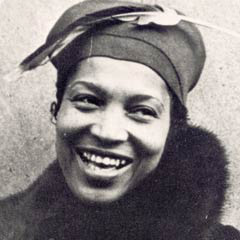 (Zora Neale Hurston) It allows us to connect and compare disparate individual instances of marriage resistance: for example, the type of autonomy claimed by Emily Dickinson, a nineteenth-century white woman genius, with the strategies available to Zora Neale Hurston, a twentieth-century black woman genius. Dickinson never married, had tenuous intellectual friendships with men, lived self-convented in her genteel father's house, and wrote a lifetime of passionate letters to her sister-in-law Sue Gilbert and a smaller group of such letters to her friend Kate Scott Anthon. Hurston married twice but soon left each husband, scrambled her way from Florida to Harlem to Columbia University to Haiti and finally back to Florida, moved in and out of white patronage and poverty, professional success and failure; her survival relationships were all with women, beginning with her mother. Both of these women in their vastly different circumstances were marriage resisters, committed to their own work and selfhood, and were later characterized as "apolitical"; both were drawn to men of intellectual quality; for both of them women provided the ongoing fascination and sustenance of life.
If we think of heterosexuality as the "natural" emotional and sensual inclination for women, lives such as these are seen as deviant, as pathological, or as emotionally and sensually deprived. Or, in more recent and permissive jargon, they are banalized as "life-styles." And the work of such women -- whether merely the daily work of individual or collective survival and resistance, or the work of the writer, the activist, the reformer, the anthropologist, or the artist -- the work of self-creation -- is undervalued, or seen as the bitter fruit of "penis envy," or the sublimation of repressed eroticism, or the meaningless rant of a "manhater." But when we turn the lens of vision and consider the degree to which, and the methods whereby, heterosexual "preference" has actually been imposed on women, not only can we understand differently the meaning of individual lives and work, but we can begin to recognize a central fact of women's history: that women have always resisted male tyranny. A feminism of action, often, though not always, without a theory, has constantly reemerged in every culture and in every period. We can then begin to study women's struggle against powerlessness, women's radical rebellion, not just in male defined "concrete revolutionary situations"{52} but in all the situations male ideologies have not perceived as revolutionary; for example, the refusal of some women to produce children, aided at great risk by other women; the refusal to produce a higher standard of living and leisure for men (Leghorn and Parker show how both are part of women's unacknowledged, unpaid, and ununionized economic contribution); that female antiphallic sexuality which, as Andrea Dworkin notes, has been "legendary", which, defined as "frigidity" and "puritanism,” has actually been a form of subversion of male power -- "an ineffectual rebellion, but rebellion nonetheless."{53}
 (Andrea Dworkin) We can no longer have patience with Dinnerstein's view that women have simply collaborated with men in the "sexual arrangements" of history; we begin to observe behavior, both in history and in individual biography, that has hitherto been invisible or misnamed; behavior that often constitutes, given the limits of the counterforce exerted in a given time and place, radical rebellion. And we can connect these rebellions and the necessity for them with the physical passion of woman for woman that is central to lesbian existence: the erotic sensuality that has been, precisely, the most violently erased fact of female experience.
Heterosexuality has been both forcibly and subliminally imposed on women, yet everywhere women have resisted it, often at the cost of physical torture, imprisonment, psychosurgery, social ostracism, and extreme poverty. "Compulsory heterosexuality" was named as one of the "crimes against women by the Brussels Tribunal on Crimes against Women in 1976. Two pieces of testimony, from women from two very different cultures, suggest the degree to which persecution of lesbians is a global practice here and now. A report from Norway relates:
A lesbian in Oslo was in a heterosexual marriage that didn't work, so she started taking tranquilizers and ended up at the health sanatorium for treatment and rehabilitation.... The moment she said in family group therapy that she believed she was a lesbian the doctor told her she was not he knew from "looking into her eyes," he said. She had the eyes of a woman who wanted sexual intercourse with her husband So she was subjected to so-called "couch therapy." She was put into a comfortably heated room, naked, on a cot and for an hour her husband was to...try to excite her sexually...The idea was that the touching was always to end with sexual intercourse. She felt stronger and stronger aversion. She threw up and sometimes ran out of the room to avoid this "treatment." The more strongly she asserted that she was a lesbian, the more violent the forced heterosexual intercourse became. This treatment went on for about six months. She escaped from the hospital, but she was brought back. Again she escaped. She has not been there since. In the end she realized that she had been subjected to forcible rape for six months.
(This, surely, is an example of female sexual slavery according to Barry's definition). And from Mozambique:
I am condemned to a life of exile because I will not deny that I am a lesbian, that my primary commitments are, and will always be to other women. In the new Mozambique, lesbianism is considered a left-over from colonialism and decadent Western civilization. Lesbians are sent to rehabilitation camps to learn through self criticism the correct line about themselves.... If I am forced to denounce my own love for women, if I therefore denounce myself, I could go back to Mozambique and join forces in the exciting and hard struggles of rebuilding a nation, including the struggle for the emancipation of Mozambiquan women. As it is, I either risk the rehabilitation camps, or remain in exile.{54}
Nor can it be assumed that women like those in Carroll Smith-Rosenberg's study, who married, stayed married, yet dwelt in a profoundly female emotional and passionate world, "preferred" or "chose" heterosexuality. Women have married because it was necessary, in order to survive economically, in order to have children who would not suffer economic deprivation or social ostracism, in order to remain respectable, in order to do what was expected of women because coming out of "abnormal" childhoods they wanted to feel "normal," and because heterosexual romance has been represented as the great female adventure, duty, and fulfillment. We may faithfully or ambivalently have obeyed the institution, but our feelings -- and our sensuality -- have not been tamed or contained within it. There is no statistical documentation of the numbers of lesbians who have remained in heterosexual marriages for most of their lives. But in a letter to the early lesbian publication Ladder, the playwright Lorraine Hansberry had this to say:
I suspect that the problem of the married woman who would prefer emotional-physical relationships with other women is proportionally much higher than a similar statistic for men. (A statistic surely no one will ever really have.) This because the estate of woman being what it is, how could we ever begin to guess the numbers of women who are not prepared to risk a life alien to what they have been taught all their lives to believe was their "natural" destiny -- AND -- their only expectation for ECONOMIC security. It seems to be that this is why the question has an immensity that it does not have for male homosexuals.... A woman of strength and honesty may, if she chooses, sever her marriage and marry a new male mate and society will be upset that the divorce rate is rising so -- but there are few places in the United States, in any event, where she will be anything remotely akin to an "outcast." Obviously this is not true for a woman who would end her marriage to take up life with another woman.{55}
This double-life -- this apparent acquiescence to an institution founded on male interest and prerogative -- has been characteristic of female experience: in motherhood, and in many kinds of heterosexual behavior, including the rituals of courtship; the pretense of asexuality by the nineteenth-century wife; the simulation of orgasm by the prostitute, the courtesan, the twentieth-century "sexually liberated" woman.
 (Meridel LeSeuer)
Meridel LeSueur's documentary novel of the Depression, The Girl, is arresting as a study of female double-life. The protagonist, a waitress in a Saint Paul working-class speakeasy, feels herself passionately attracted to the young man Butch, but her survival relationships are with Clara, an older waitress and prostitute, with Belle, whose husband owns the bar, and with Amelia, a union activist. For Clara and Belle and the unnamed protagonist, sex with men is in one sense an escape from the bedrock misery of daily life; a flare of intensity in the grey, relentless, often brutal web of day-to-day existence:
It was like he was a magnet pulling me. It was exciting and powerful and frightening. He was after me too and when he found me I would run, or be petrified, just standing in front of him like a pony. And he told me not to be wandering with Clara to the Marigold where we danced with strangers. He said he would knock the shit out of me. Which made me shake and tremble, but it was better than being a husk full of suffering and not knowing why.{56}
Throughout the novel the theme of double-life emerges; Belle reminisces of her marriage to the bootlegger Hoinck:
You know, when I had that black eye and said I hit it on the cupboard, well he did it the bastard, and then he says don't tell anybody.... He's nuts, that's what he is, nuts, and I don't see why I live with him, why I put up with him a minute on this earth. But listen kid, she said, I'm telling you something. She looked at me and her face was wonderful. She said, Jesus Christ, Goddam him I love him that's why I'm hooked like this all my life, Goddam him I love him.{57}
After the protagonist has her first sex with Butch, her women friends care for her bleeding, give her whiskey, and compare notes.
My luck, the first time and I got into trouble, he gave me a little money and I come to St. Paul where for ten bucks they'd stick a huge vet's needle into you and you start it and then you were on your own.... I never had no child. I've just had Hoinck to mother, and a hell of a child he is.{58}
Later they made me go back to Clara's room to lie down.... Clara lay down beside me and put her arms around me and wanted me to tell her about it but she wanted to tell about herself. She said she started it when she was twelve with a bunch of boys in an old shed. She said nobody had paid any attention to her before and she became very popular.... They like it so much, she said, why shouldn't you give it to them and get presents and attention? I never cared anything for it and neither did my mama. But it's the only thing you got that's valuable.{59}
 (Toni Morrison)
Sex is thus equated with attention from the male, who is charismatic though brutal, infantile, or unreliable. Yet it is the women who make life endurable for each other, give physical affection without causing pain, share, advise, and stick by each other. (I am trying to find my strength through women -- without my friends, I could not survive.) LeSueur's The Girl parallels Toni Morrison's remarkable Sula, another revelation of female double-life: Nel was the one person who had wanted nothing from her, who had accepted all aspects of her.... Nel was one of the reasons [Sula] had drifted back to Medallion.... The men ... had merged into one large personality: the same language of love, the same entertainments of love, the same cooling of love. Whenever she introduced her private thoughts into their rubbings and goings, they hooded their eyes. They taught her nothing but love tricks, shared nothing but worry, gave nothing but money. She had been looking all along for a friend, and it took her a while to discover that a lover was not a comrade and would never be -- for a woman. But Sula's last thought at the second of her death is, "Wait'll I tell Nel." And after Sula's death, Nel looks back on her own life: "All that time, all that time, I thought I was missing Jude." And the loss pressed down on her chest and come up into her throat. "We was girls together," she said as though explaining something. "O Lord, Sula," she cried, "Girl, girl, girlgirlgirl!" It was a fine cry -- loud and long -- but it had no bottom and it had no top, just circles and circles of sorrow.{60}
The Girl and Sula are both novels that reveal the lesbian continuum in contrast to the shallow or sensational "lesbian scenes" in recent commercial fiction.{61} Each shows us woman-identification untarnished (till the end of LeSueur's novel) by romanticism; each depicts the competition of heterosexual compulsion for women's attention the diffusion and frustration of female bonding that might, in a more conscious form, reintegrate love with power.
IV. Woman-identification is a source of energy, a potential springhead of female power, violently curtailed and wasted under the institution of heterosexuality. The denial of reality and visibility to women's passion for women, women's choice of women as allies, life companions, and community; the forcing of such relationships into dissimulation and their disintegration under intense pressure, have meant an incalculable loss to the power of all women to change the social relations of the sexes, to liberate ourselves and each other. The lie of compulsory female heterosexuality today admits not just feminist scholarship, but every profession, every reference work, every curriculum, every organizing attempt, every relationship or conversation over which it hovers. It creates, specifically, a profound falseness, hypocrisy, and hysteria in the heterosexual dialogue, for every heterosexual relationship is lived in the queasy strobelight of that lie: however we choose to identify ourselves, however we find ourselves labeled, it flickers across and distorts our lives.{62}
The lie keeps numberless women psychologically trapped, trying to fit mind, spirit, and sexuality into a prescribed script because they cannot look beyond the parameters of the acceptable. It pulls on the energy of such women even as it drains the energy of "closeted" lesbians -- the energy exhausted in the double-life. The lesbian trapped in the "closet," the woman imprisoned in prescriptive ideas of the "normal," share the pain of blocked options, broken connections, lost access to self-definition freely and powerfully assumed.
The lie is many-layered. In Western tradition, one layer -- the romantic -- asserts that women are inevitably, even if rashly and tragically, drawn to men; that even when that attraction is suicidal (e g, Tristan und Isolde, Kate Chopin’s The Awakening) it is still an organic imperative. In the tradition of the social sciences it asserts that primary love between the sexes is “normal,” that women need men as social and economic protectors, for adult sexuality, and for psychological completion; that the heterosexually constituted family is the basic social unit; that women who do not attach their primary intensity to men must be, in functional terms, condemned to an even more devastating outsiderhood than their outsiderhood as women. Small wonder that lesbians are reported to be a more hidden population than male homosexuals. The black lesbian/feminist critic, Lorraine Bethel, writing on Zora Neale Hurston, remarks that for a black woman -- already twice an outsider -- to choose to assume still another "hated identity" is problematic indeed. Yet the lesbian continuum has been a lifeline for black women both in Africa and the United States.
Black women have a long tradition of bonding together in a Black/women's community that has been a source of vital survival information, psychic and emotional support for us. We have a distinct Black woman-identified folk culture based on our experiences as Black women in this society, symbols language and modes of expression that are specific to the realities of our lives. Because Black women were rarely among those Blacks and females who gained access to literary and other acknowledged forms of artistic expression, this Black female bonding and Black woman-identification has often been hidden and unrecorded except in the individual lives of Black women through our own memories of one particular Black female tradition.63
Another layer of the lie is the frequently encountered implication that women turn to women out of hatred for men. Profound skepticism, caution, and righteous paranoia about men may indeed be part of any healthy woman's response to the woman-hatred embedded in male-dominated culture, to the forms assumed by "normal" male sexuality, and to the failure even of "sensitive" or "political" men to perceive or find these troubling. Yet woman-hatred is so embedded in culture, so "normal" does it seem, so profoundly is it neglected as a social phenomenal, that any women, even feminists and lesbians, fail to identify it until it takes, in their own lives, some permanently unmistakable and shattering form. Lesbian existence is also represented as mere refuge from male abuses, rather than as an electric and empowering charge between women. I find it interesting that one of the most frequently quoted literary passages on lesbian relationship is that in which Colette's Renee, in The Vagabond, describes "the melancholy and touching image of two weak creatures who have perhaps found shelter in each other's arms, there to sleep and weep, safe from man who is often cruel, and there to taste better than any pleasure, the bitter happiness of feeling themselves akin, frail and forgotten [emphasis added]."{64} Colette is often considered a lesbian writer; her popular reputation has, I think, much to do with the fact that she writes about lesbian existence as if for a male audience her earliest "lesbian" novels, the Claudene series, were written under compulsion for her husband and published under both their names. At all events, except for her writings on her mother, Colette is a far less reliable source on lesbian existence than, I would think, Charlotte Bronte, who understood that while women may, indeed must, be one another's allies, mentors, and comforters in the female struggle for survival, there is quite extraneous delight in each other's company and attraction to each others' minds and character, which proceeds from a recognition of each others' strengths.
By the same token, we can say that there is a nascent feminist political content in the act of choosing a woman lover or life partner in the face of institutionalized heterosexuality.{65} But for lesbian existence to realize this political content in an ultimately liberating form, the erotic choice must deepen and expand into conscious woman identification -- into lesbian/feminism.
The work that lies ahead, of unearthing and describing what I call here lesbian existence, is potentially liberating for all women. It is work that must assuredly move beyond the limits of white and middle-class Western women's studies to examine women's lives, work, and groupings within every racial, ethnic, and political structure. There are differences, moreover, between lesbian existence and the lesbian continuum -- differences we can discern even in the movement of our own lives. The lesbian continuum, I suggest, needs delineation in light of the double-life of women, not only women self-described as heterosexual but also of self-described lesbians. We need a far more exhaustive account of the forms the double-life has assumed. Historians need to ask at every point how heterosexuality as institution has been organized and maintained through the female wage scale, the enforcement of middle-class women's "leisure", the glamorization of so-called sexual liberation, the withholding of education from women, the imagery of "high art" and popular culture, the mystification of the "personal" sphere, and much else. We need an economics that comprehends the institution of heterosexuality, with its doubled workload for women and its sexual divisions of labor, as the most idealized of economic relations.
The question inevitably will arise: Are we then to condemn all heterosexual relationships, including those that are least oppressive? I believe this question, though often heartfelt, is the wrong question here. We have been stalled in a maze of false dichotomies that prevents our apprehending the institution as a whole: "good" versus "bad" marriages; "marriage for love" versus arranged marriage; "liberated" sex versus prostitution; heterosexual intercourse versus rape; Liebeschmerz versus humiliation and dependency. Within the institution exists, of course, qualitative differences of experience; but the absence of choice remains the great unacknowledged reality, and in the absence of choice, women will remain dependent on the chance or luck of particular relationships and will have no collective power to determine the meaning and place of sexuality in their lives. As we address the institution itself, moreover, we begin to perceive a history of female resistance that has never fully understood itself because it has been so fragmented, miscalled, erased. It will require a courageous grasp of the politics and economics, as well as the cultural propaganda, of heterosexuality to carry us beyond individual cases or diversified group situations into the complex kind of overview needed to undo the power men everywhere wield over women, power that has become a model for every other form of exploitation and illegitimate control.
 (Poster from late 1970s, reprints available from Chicago Women's Liberation Union Herstory Project)
NOTES
1. Alice Rossi, "Children and Work in the Lives of Women," paper delivered at the University of Arizona, Tucson, February 1976.
2. Doris Lessing, The Golden Notebook (1962; New York: Bantam Books, 1977), P.480.
3. Nancy Chodorow, The Reproduction of Mothering (Berkeley: University of California Press, 1978); Dorothy Dinnerstein, The Mermaid and the Minotaur: Sexual Arrangements and the Human Malaise (New York: Harper and Row, 1976); Barbara Ehrenreich and Deirdre English, For Her Own Good: 150 Years of the Experts' Advice to Women (Garden City, N.Y.: Doubleday/& Anchor, 1978); Jean Baker Miller, Toward a New Psychology of Women (Boston Beacon Press, 1976).
4. I could have chosen many other serious and influential recent books, including anthologies, that would illustrate the same point: e.g., Our Bodies, Ourselves, the Boston Women's Health Collective's bestseller (New York: Simon and Schuster. 1976), which devotes a separate (and inadequate) chapter to lesbians, but whose message is that heterosexuality is most women's life preference; Berenice Carroll, ed., Liberating Women's History: Theoretical and Critical Essays (Urbana: University of Illinois Press, 1976), which does not include even a token essay on the lesbian presence in history, though an essay by Linda Gordon, Persis Hunt, et al. notes the use by male historians of "sexual deviance" as a category to discredit and dismiss Anna Howard Shaw, Jane Addams, and other feminists ("Historical Phallacies: Sexism in American Historical Writing"); and Renate Bridenthal and Claudia Koontz, eds., Becoming Visible: Women In European History (Boston: Houghton Mifflin, 1977), which contains three mentions of male homosexuality but no materials that I have been able to locate on lesbians. Gerda Lerner, ed., The Female Experience: An American Documentary (Indianapolis Bobbs-Merrill, 1977), contains an abridgment of two lesbian/feminist position papers from the contemporary movement but no other documentation or lesbian existence. Lerner does note in her preface, however, how the charge of deviance has been used to fragment women and discourage women's resistance. Linda Gordon, in Woman's Rights: A Social History of Birth Control In America (New York: Viking Press, 1976), notes accurately that "it is not that feminism has produced more lesbians. There have always been many lesbians, despite high levels or repression; and most lesbians experience their sexual preference as innate" (p. 410).
5. Jonathan Katz, Gay American History (New York: Thomas Y. Crowell, 1976).
6. Nancy Sahli,,"Smashing: Women's Relationships Before the Fall," Chrysalis:. A Magazine of Women's Culture 8(1979): 17-27. A version of the article was presented at the Third Berkshire Conference on the History of Women, June 11, 1976.
7. This is a book I have publicly endorsed. I would still do so, though the above caveat. It is only since beginning to write this article that I fully appreciated how enormous is the unmasked question in Ehrenreich and English's book.
8. Kathleen Barry, Female Sexual Slavery (Englewood Cliffs, N.J.: Prentice-Hall, 1979); Susan Brownmiller, Against Our Will: Men, Women, and Rape (New York: Simon and Schuster, 1975); Mary Daly, Gyn/Ecology: The Meta-Ethics of Radical Feminism (Boston: Beacon Press, 1978); Susan Griffin, Woman and Nature: The Roaring Inside Her (New York: Harper and Row, 1978); Diana Russell and Nicole van de Vens, eds., Proceedings of the International Tribunal on Crimes Against Women (Millbrae, Calif.: Les Femmes, 1976).
9.Dinnerstein, Mermaid, p. 272.
10. Daly, Gyn/Ecology. pp. 184--85; 114 33.
11. Chodorow, Reproduction of Mothering, pp. 197-98.
12. Ibid., pp. 198-99.
13. Ibid., p. 200.
14. Kathleen Gough, "The Origin of the Family," in Toward an Anthropology of Women, ed. Rayna Reiter (New York: Monthly Review Press, 1975). pp. 69-70.
15. Barry, Female Sexual Slavery, pp. 216-19.
16. Anna Demeter, Legal Kidnapping (Boston: Beacon Press, 1977), pp. xx, 126-28.
17. Daly, Gyn/Ecology, pp. 132, 139-41, 163-65.
18. Barbara Ehrenreich and Deirdre English, Witches, Midwives, and Nurses: A History of Women Healers (Old Westbury, N.Y.: Feminist Press, 1973); Andrea Dworkin, Woman Hating, (New York: E.P. Dutton, 1974), pp. 118-54; Daly, Gyn/Ecology, pp. 178-222.
19. See Virginia Woolf, A Room of One’s Own (London: Hogarth Press, 1929), and idem, Three Guineas (l938; New York: Harcourt Brace,1966); Tillie Olsen, Silences (Boston: Delacorte Press, 1978); Michelle Cliff, "The Resonance of Interruption," Chrysalis: A Magazine of Women's Culture 8 (1979): 29-37.
20. Mary Daly, Beyond God the Father (Boston Beacon Press, 1973), pp. 347-51; Olsen, Silences, pp. 22 46.
21. Daly, Beyond God The Father, p. 93.
22.Fran P. Hosken, "The Violence of Power: Genital Mutilation of Females", Heresies 6 (1979): 28-35; Russell and van de Ven, Proceedings, pp. 194-95.
23. Barry, Female Sexual Slavery, pp. 163-64.
24. The issue of "lesbian sadomasochism“ needs to be examined in terms of the dominant cultures' teachings about the relation of sex and violence, and also of the acceptance by some lesbians or male homosexual mores. I believe this to be another example of the double-life of women.
25.Catherine A. MacKinnon, Sexual Harassment of Working Women: A Case of Sex Discrimination (New Haven, Conn.: Yale University Press, 1979), pp. 15-16.
26. Ibid., p. 174.
27. Brownmiller, Against Our Will.
28. MacKinnon, Sexual Harassment, p. 219. Susan Schecter writes: "The push for heterosexual union at whatever cost is so intense that . . . it has become a cultural force of its own that creates battering. The ideology of romantic love and its jealous possession of the partner as property provide the masquerade for what can become severe abuse" (Aegis: Magazine on Ending Violence Against Women [July-August 1979]: 50-51).
29. MacKinnon, Sexual Harassment, p. 298.
30. Ibid., p. 220.
31. Ibid., p. 221.
32. Barry, Female Sexual Slavery.
33. Ibid., p. 33.
34. Ibid., p 103.
35. Ibid., p. 5.
36. Ibid., p. 100.
37. Ibid., p. 218.
38. Ibid., p. 140.
39. Ibid., p. 172
40. Elsewhere I have suggested that male-identification has been a powerful source of male codes and systems who have actively battled against it (Adrienne Rich, “Disloyal to Civilization: Feminism, Racism, Genephobia,” in On Lies, Secrets and Silence: Selected Prose, 1966-1978 [New York: W.W. Norton, 1979]).
41. Barry, Female Sexual Slavery, p. 220.
42. Susan Cavin, “Lesbian Origins,” Ph.D diss., Department of Sociology, Rutgers, The State University of New Jersey, 1978, chap. 6.
43. For my perception of heterosexuality as an economic institution, I am indebted to Lisa Leghorn and Katherine Parker, who allowed me to read the unpublished manuscript of their book, Woman’s Worth: Sexual Economics and the World of Women (London and Boston: Routledge and Kegan Paul, 1981).
44. I would suggest that lesbian existence has been most recognized and tolerated where it has resembled a “deviant” version of heterosexuality; e.g., where lesbians have, like Stein and Toklas, played heterosexual roles (or seemed to in public) and have been chiefly identified with male cultures. See also Claude E. Schaeffer, “The Kuterai Female Berdache: Courier, Guide, Phophetess and Warrier,” Ethnohistory 2, no. 3 (Summer 1965): 193-236. (Berdache: “an individual of a definite physiological sex [m. or f.] who assumes the role and status of the opposite sex and who is viewed by the community as being of one sex physiologically but as having assumed the role and status of the opposite sex” [Schaeffer, p. 231.] Lesbian existence has also been relegated to an upper-class phenomenon, an elite decadence (as in the fascination with Paris salon lesbians such as Renee Vivien and Natalie Clifford Barney), to the obscuring of such “common women” as Judy Grahn depicts in her The Work of a Common Woman (New York: St,. Martin’s Press, 1980) and True to Life Adventure Stories (Oakland, Calif.: Diana Press.
45. Daly, Gyn/Ecology, p. 15.
46. “In a hostile world in which women are not supposed to survive except in relation with and in service to men, entire communities of women were simply erased. History tends to bury what it seeks to reject” (Blanche W. Cook, “Women Alone Stir My Imagination: Lesbianism and the Cultural Tradition,” Signs 4, no. 4 [Summer 1979]; 719-20]. The Lesbian Herstory Archives in New York City is one attempt to preserve contemporary documents on lesbian existence —- a project of enormous value and meaning, still pitted against the continuing censorship and obliteration of relationships, networks, communities, in other archives and elsewhere in the culture.
47. Audre Lorde, Uses of the Erotic: The Erotic as Power, Out & Out Books Pamphlet No. 3 (New York: Out & Out Books [476 2d Street, Brooklyn, New York 11215], 1979)
48. Adrienne Rich, “The conditions for Work: The common World of Women,” in On Lies, Secrets, and Silence, p. 209; H.D., Tribute to Freud (Oxford: Carcanet Press, 1971), pp. 50-54.
49. Woolf, A Room of One’s Own, p. 126.
50. Gracia Clark, “The Beguines: A Mediaeval Women’s Community,” Quest: A Feminist Quarterly 1, no. 4 (1975): 73-80.
51. See Denise Paulme, ed., Women of Tropical Africa (Berkeley: University of California Press, 1963), pp. 7, 266-67. Some of these sororities are described as “a kind of defensive syndicate against the male element” — their aims being “to offer concerted resistance to an oppressive patriarchate,” independence in relation to one’s husband and with regard to motherhood, mutual aid, satisfaction of personal revenge.” See also Audre Lorde, “Scratching the Surface: Some Notes on Barriers to Women and Loving,” Black Scholar 9, no. 7 (1978): 31-35; Marjorie Topley, “Marriage Resistance in Rural Kwangtung,” in Women in Chinese Society, ed. M. Wolf and R. Witke (Stanford, Calif.: Stanford University Press, 1978), pp. 67-89; Agnes Smedley, Portraits of Chinese Women in Revolution, ed. J. MacKinnon and S. MacKinnon (Old Westbury, NY: Feminist Press, 1976), pp. 103-10.
52. See Rosalind Petchesky, “Dissolving the Hyphen: A Report on Marxist-Feminist Groups 1-5,” in Capitalist Patriarcy and the Case for Socialist Feminism, ed. Zillah Eisenstein (New York: Monthly Review Press, 1979) p. 387.
53. Andrea Dworkin, Pornography: Men Possessing Women (New York: G. P. Putnam Sons, 1981).
54. Russell and van de Ven, Proceedings, pp. 42-43, 56-57.
55. I am indebted to Jonathan Katz’s Gay American History for bringing to my attention Hansberry’s letters to Ladder and to Barbara Grier for supplying me with copies of relevant pages from Ladder, quoted here by permission of Barbara Grier. See also the reprinted series of Ladder, ed. Jonathan Katz et al. (New York: Arno Press); and Diedre Carmody, “Letters by Eleanor Roosevelt Detail Friendship with Lorena Hickok,” New York Times, 21 October 1979.
56. Meridel LeSueur, The Girl (Cambridge, Mass.: West End Press, 1978), pp. 10-11. LeSueur describes, in an afterword, how this book was drawn from the writings and oral narrations of women in the Workers Alliance who met as a writer’s group during the Depression.
57. Ibid., p. 20.
58. Ibid., pp. 53-54.
59. Ibid., p. 55.
60. Toni Morrison, Sula (New York: Bantam Books, 1973), pp. 103-4, 149. I am indebted to Lorraine Bethel’s essay, “This Infinity of Conscious Pain: Zora Neale Hurston and the Black Female Literary Tradition,” in All the Women Are White, All the Blacks Are Men, But Some of Us Are Brave: Black Women’s Studies, ed. Gloria T. Hull, Patricia Bell Scott, and Barbara Smith (Old Westbury, N.Y.: The Feminist Press, 1982.)
61. See Maureen Brady and Judith McDaniel, “Lesbians in the Mainstream: The Image of Lesbians in Recent Commercial Fiction,” Conditions 6 (1979).
62. See Russell and van de Ven, Proceedings p. 40: “ . . . few heterosexual women realize their lack of free choice about their sexuality, and few realize how and why compulsory heterosexuality is also a crime against them.”
63. Bethel, “This Infinity of Conscious Pain.”
64. Dinnerstein, the most recent writer to quote this passage, adds ominously: “But what has to be added to her account is that these ‘women enlaced’ are sheltering each other not just from what men want to do to them, but also from what they want to do to each other” (The Mermaid, p. 103). The fact is, however, that women-to-woman violence is a minute grain in the universe of male-against-female violence perpetrated and rationalized in every social institution.
65. Conversation with Blanche W. Cook, New York City, March 1979.
Read More...
Summary only...


+_1B3463.JPG)


 Posts
Posts